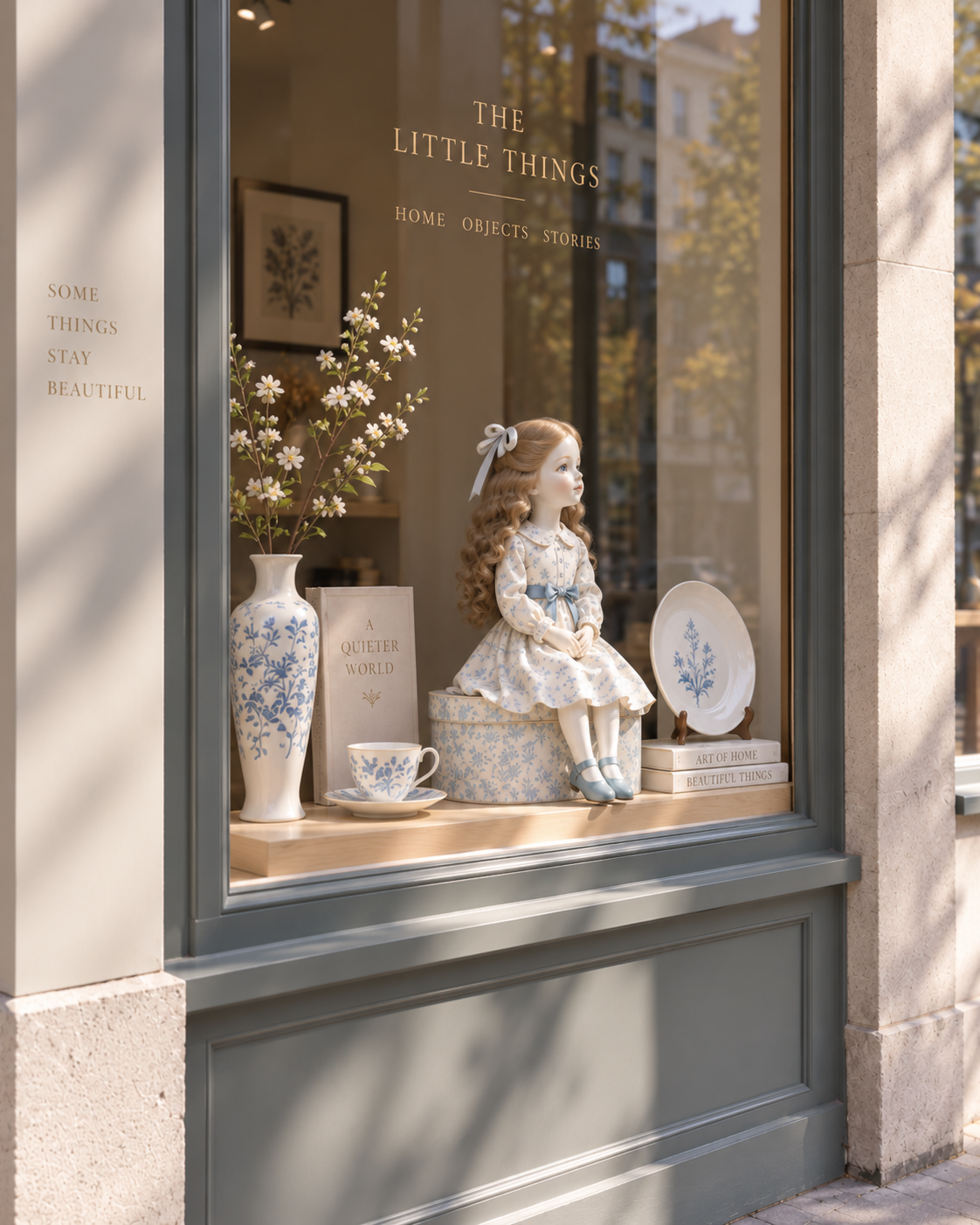
The Porcelain Doll
There are no safe routes. Take that from an expert on safe routes. I have meticulously navigated the river of my life avoiding the jetties and faster currents that offered more adventurous but less certain possibilities. I never stopped longer on any particular shore or ventured farther inland than necessary to sustain myself on my safe journey. I disturbed nothing. The only mark of my existence lay in my own memories and those of the ones I loved. And yet I became lost in rapids of my own creation. I am not a religious man, at least not in the conventional sense. I have prayed on occasion, to no particular deity, when it was convenient. Nevertheless, it is obvious to me that once lost I was guided by unseen currents to a predictable and unavoidable outcome.
A little over three years ago I was spending most of my afternoons in a sullen hospital room where my wife lay dreaming away the last days of her life. She was comatose, an innocent victim of a senseless accident. I sat on a chair next to her bed and told her all the things I should have told her in better times, praying she could understand or wake up. Mostly I would stare out the wall sized window with the view of the harbor. It was comforting to watch the ships slowly make their way to the river where they became small black silhouettes and eventually disappeared.
We had married young after a brief courtship. Our early years were typical of that of young couples; small apartment, tight budgets, and optimism. Two sons came along too soon and the latent awareness of greater problems were consumed in the fires of the moment. As the years past and we prospered financially, we slowly began to expose the hidden faults in our marriage. I should say my faults for she gave of herself willingly and completely. I, on the other hand, was unable or unwilling to share in that mutual giving which binds a couple's soul and makes them forever inseparable. I can see now how she must have felt cheated and I regret it deeply. However, it left a gap we could not bridge. Perhaps it was the children or the basic symmetry of our ideals, but whichever, we were content to settle into a loving if passionless union.
The end came on a sunny summer morning and though the world around me was hot, I felt a chill that the sun could not reach.
In the gray days that followed I lost myself in my work. I had no interest in social activities and my circle of friends gradually grew smaller until I was alone. My unmarried sister moved in to help take care of the boys and the approach of Autumn only brought the promise of a cold winter.
Often I would visit her grave sight, seeking some refuge from my sorrow. The cemetery had no raised monuments, only ground level bronze markers. I would read the markers as I walked the bleached concrete paths that wound through the acres of manicured lawn. I began to mark the inexorable change of season by the subtle changes in the shrubbery and the falling leaves of the sparsely scattered trees. Soon the first light snow covered the ground and I brushed clear our marker as had a few others. On the right side was my name and birth date, on the left side in raised letters was the three line synopsis of her life. As I brushed the snow from the letters I tried to feel for some sense of her being that would reside in this lonesome place, but I felt only the icy metal on my fingertips.
It was not long after that first snow that my car developed some engine trouble and had to stay in the shop for repairs. During this time it was necessary to find some alternate transportation to work. My office was in the city, only a short walk from the bus line. Through night school and diligence I had reached a position which gave me some control over my schedule and provided me with a private parking spot in a small lot behind our building. I enjoyed the flexibility this gave me, but more importantly, it allowed me to visit the cemetery on a regular basis. So I looked at the situation as a matter of considerable inconvenience.
Nevertheless, on this particular day I was forced to take the bus. It was a crowded yet pleasant enough ride from the suburbs to the heart of the city. The route even took me through south Brookfield, a rotting semi-poverty-ridden section which was the playground of my youth. It was fun to watch the street signs pass by and reminisce. School kids still crowded the bus stop in front of Tubb's toy store where I had spent many a frigid morning waiting for my bus. The shabbily dressed youngsters heading for public schools mingled with the Catholic girls in their pressed uniforms. Several of the boys were headed to my old high school as evidenced by their jackets of blue corduroy trimmed in orange. I used to have a crush on one of the Catholic girls who shared that stop and I remembered confessing it to her on one of those mornings. Things had changed however, and Tubb's was now a surplus store for cheap furniture.
The bus finally made a stop several blocks from my office and I departed with the crowd. It was late November and the city was already decked out in it's holiday costume. I have always loved the city, especially around the holidays and my walk was a pleasant one past an odd assortment of shops. It was amusing to see how the store windows were decorated, each trying to link the spirit of Christmas with its particular ware in some unique way. One window fascinated me more than the others, and not for the decorations, for it had none, but rather for the little porcelain doll centered among the other debris.
The little curio shop sat on a side street opposite the main shopping thoroughfare. I had passed it many times on my way to lunch or in my car, never paying it much attention. I don't think the window display had changed that much over the years. In one corner a small cigar store indian held a sign which read "WE TRADE". The rest of the window was filled with lamps, jewelry, and other odd artifacts. All in all it was a sad collection of gaudy antiques, with the exception of the little porcelain lady who stood alone in the center.
The doll was about nine inches high and her dress and hair style were of a period I could not distinguish. She had a modern appearance in an old fashioned kind of way. Her plain dress was made of deep blue velvet with a sash and tiny pressed lace collar. The dress was starchily unwrinkled and molded to a lithe, even sensuous little body. Her black hair was styled up and the slivers of a matching bow fell down on her back. Most fascinating of all was her face, a hauntingly half-familiar face, which her maker had formed to a smooth porcelain perfection. That is with the exception of her nose which was slightly crooked. This minor defect flawed her perfect beauty and yet it endeared her to me. I was strangely fascinated by the little lady, and in the days that followed that fascination was replaced by fondness.
The bus ride to work soon became a ritual, even after my car was repaired, because the walk took me past the little curio shop with the doll in the window. As the days passed we came to know each other. She became Katherine and we exchanged pleasantries each morning and evening.
"Good morning, Katie, yeah I know I'm late. See you after work."
Each evening I would stop and comment about my day. She was always there, smiling.
The little shop closed earlier than the stores on the main street. In the city the evening shopper was not likely to venture far from the lights and the security of the crowd. On the days when I worked late I would often find the shop closed and the street deserted. On these nights I would linger and confide in her my feelings about things deeper than the events of the day.
The things in her window were a part of her home. A special place which I shared and came to know.
"Well Katherine, I see you got rid of that old brooch. You never did like that thing. See you in the morning."
So the days passed and then the years. Each day I would visit my neatly dressed little porcelain lady and each day she would smile her crooked smile. My fondness grew into love for she touched something deep inside. And yet it seemed that she touched me alone because for years she stood alone in that store window, unmoving smiling with her crooked nose at all passersby.
Many times I was tempted to go inside the shop and buy the little doll, but some subliminal system of checks and balances kept me out. The artist knows that for his work to be meaningful it must come from within, but that also means sharing a part of his private self. Though I had not created the little doll, she exposed all that was inside me and that was a price I was not prepared to pay. And so we went on, our love safely separated by the window glass.
The curio shop did a minor business. This was evident by the rare change in the display case. One morning there appeared a ceramic doll, a small girl with curls. She wore a yellow dress lined with small cut glass stones. On the tip of her finger perched a pink butterfly which she stared at with alabaster curiosity.
"So Katie, I see we've got ourselves a little girl to look after. Well its about time, I know how you've always wanted children."
Often when I would leave work in the evening it would already be dark. The city lights would be shining and the curio store window would be bathed in a soft yellow glow.
"Well Katherine, how was your day? Has our little girl figured out that butterfly yet?"
The little porcelain figure would answer as always with her soft crooked smile and I love her more.
"Good Night Katie."
My whisper faded into the other city noise as I walked to catch my bus.
Deep evening would often find me alone in my cozy family room. I would sit watching the dying embers of the evenings fire. Tired and drugged by light wine my thoughts would turn to dreams and desires unfulfilled. In time my thoughts would turn to Katie and I would close my eyes and find passion with my imaginary lover, the little lady with the porcelain smile.
One evening as I made my accustomed call, a fellow worker stopped to talk. I was caught off guard and sure she would discover my deep kept secret. Embarrassed, I avoided looking at my little doll, instead I commented about the beauty of some grotesque piece of jewelry and hastily headed off to my bus.
The ride home was a restless one. The bus was filled with half familiar faces, each secretly aware of my transgressions. I sat staring at my reflection in the black window. I was sad and I hated myself. I hated myself for my embarrassment and I hated myself for my shame. How could I ever be ashamed of Katie? The ride took our group of travelers far from the city lights. Stop by stop the carriage slowly emptied until I sat alone. There was always something strange about being the last passenger at the last stop. The driver never said a word but pulled off the main road and opened the side door. As I stepped from the bus I was shocked by the cold night air.
The next morning I went through my usual routine. I stepped off the bus and briskly walked to the little curio shop. All was just as before, the Indian held his sign, the little girl wondered at the butterfly, and Katie smiled at me as always. Relieved I went to work.
It happened that evening. I left work later than usual. Darkness had fallen and the street lights made the sidewalks a melancholy yellow. The curio shop was bathed as always in that soft gold, unchanged except for the spot where Katie had stood for the last two Years.
I was unable to move. I scanned the entire display in the hope that she had just been moved. She was gone. I tried the door but the shop was locked, and only a small night lamp glowed in the back. The empty spot where she had stood for so long stared back at me like a hole in my life. I closed my eyes and prayed when I opened them that she would somehow reappear, but only the Indian and the girl remained, oblivious to the loss of their friend. I began to walk in no particular direction and cried.
I walked for hours and perhaps through habit I found myself on the old bridge that linked the main portion of the city with Brookfield. The wind whipped off the water and the cars sped by in an unending stream. I leaned over the retaining wall, staring blankly at the ripples of frigid water below. My thoughts raced through my mind like children‘s flashcards. I was guilty. I had betrayed my wife. Katherine was gone. I needed her back. She was only a doll. I was insane! The water loomed comforting below and for a moment I wanted to fly outward and disappear into the black abyss. Once again an unconscious force pulled me back from the edge. I walked across the bridge toward Brookfield and home.
Several days passed and I hoped against hope that she would reappear, but it was not to be. Several times I was tempted to find out who had taken the little doll but I knew it was useless. A week passed and then two and when Katie did not come back I began to drive to work.
I spent most of my days trying to analyze and understand what had happened. That too was useless, objectivity had deserted me and left me only with an overwhelming sense of loss. At night my dreams became a surrealistic collage of past and present events. In a recurring theme I kept trying to get home to my wife and kids, but it was always my childhood home and invariably Katie would be waiting at the door.
In one dream we were alone. Katie took me to my old room where we began to undress and make love. I had had similar dreams before but had always awoken prematurely, this time I did not. When I opened my eyes I stared through the darkness to the window and the pale moon beyond, the sweat of passion still on my brow. Thereafter the dreams stopped, or at least I could no longer remember them.
**************
The winter sky was a silvery blue and the morning sun beamed across the papers on my desk. I decided to take a walk and an early lunch. The city air had that soft briskness of winter’s end and the gutters were wet with melted snow. I bought a coke and hot dog piled high with steaming sauerkraut from a street vendor. The city streets were filled with others who sensed the coming of spring and eagerly escaped stuffy offices. My tour found me eventually in. front of the little curio shop. Nothing had changed. The indian still stood and the little girl watched the butterfly.
"She's lovely isn't she?"
I was startled by the unexpected company and turned to see the vaguely familiar face of the lady who had made the comment.
"Yes she is."
"My mother used to have one exactly like it.” She stared longingly at the doll, "I always wanted it, but when my mother died it somehow wound up with my older sister."
I couldn't help smiling at her for she had large happy eyes and a friendly face.
"Why don't you buy her?"
"I've thought about it, but I've never been able to bring myself to do it. I suppose she'll be gone one day and I'll kick myself for not buying her."
Her words held a truth and sadness for me that she could not have imagined, but she made the remark in such a light and off-handed way that I had to smile.
"Well in the final analysis it’s the memories that really count."
"I suppose you’re right, though it’s nice to have something you can touch." she smiled, "But she's fairly expensive and I'm lucky I can eat on my salary."
"Maybe I could buy you lunch sometime after all, I wouldn't want to see you starve." The words came out before I realized what I had said.
The lady turned to me with a surprised look on her face.
"Don't I know you from somewhere?" I blurted out. "Oh God, I must sound like something right out of a singles bar."
She smiled, "We haven't met, but you used to ride the bus. I used to see you when I was running late. We would get off at the same stop. I work just across the street."
She pointed to her building which was opposite my own and recognized someone. She looked at her watch.
"I've got to go."
"Maybe I'll see you on the bus?" Again I was surprised by my own words.
"I'd like that," she said smiling as she headed back to work, "and I'll take you up on that lunch."
I took of early and visited the cemetery for the first time in over two years. The sun had been shining all day and the warm air was alive with the scents of mock spring. I stood at my wife's marker and tried to find some cause for the strange compulsion that had brought me. At last I laid the bouquet of flowers gently below her name and said good-by.
That night I sat holding a rose that I had taken from the bouquet in the afternoon. I watched the evening fire until the last embers could no longer keep a flame. I partially closed the glass doors and in a few moments the fire came back to life. I selected a rarely used volume from the shelf and turned to a familiar passage. Gently, I selected a petal from the rose, and pressed it between the pages of the book. My trembling hands placed the book back in its accustomed spot. I tossed the rose into the fire and watched as the crimson flower melted slowly into the flames.
Across the room, on a table by itself, the little girl stared with wonderment at the butterfly perched on her finger.
Robert Reichert